
Overview
Current digital twins (DTs) utilize cutting-edge technologies such as IoT, 5G, Cloud, AI, and 3D modeling. However, DT development entails high costs and lengthy implementation times, underscoring the need for a new specialized methodology.
Engineering digital twins (EDT) involves multiple disciplines and relies on various technologies and research areas. This multidisciplinarity necessitates the definition of domain-specific languages (DSL) and specific viewpoints to be integrated into a coherent global architecture framework as defined in ISO42010.
Any complex system development must begin with good specification, and DT development is no exception. The project investigates the specificities of DT development to support their formal specification (e.g., how do you specify the expected level of precision of a digital twin?).
Conformity assessment of digital twins according to existing standards and regulations is essential to build user confidence in real-world DT deployment. This project explores the integration of AI and Model-Based Systems Engineering (MBSE) practices to automate conformity assessment activities.
DTs are complex systems, and their engineering field requires new tools that support tightening collaborative engineering to reduce costs and delays and improve quality. Concurrent and agile engineering and better knowledge sharing are necessary. The project also addresses integrating AI into engineering methodologies for DT and their Integrated Development Environment (Augmented-IDE), investigating human-bot inclusion and ensuring the Augmented IDE adapts to all users, regardless of their cognitive, economic, social, or cultural levels.
Integrating analysis tools and techniques early in the design phase, especially when using MBSE approaches, is crucial. This early analysis can improve decision-making, and “analysis-in-the-loop” can help assess the impacts of design choices on key performance indicators.
The growing importance of AI models integrated into DT requires intensive testing procedures. Testing machines using or “embedding” DTs is a critical question. New methods for verifying, validating, and qualifying uncertainties (VVUQ) will be proposed and integrated into a common methodology, supporting continuous integration and deployment.
The environmental impact of digital systems is a reality. DT design and operations need to be optimized to minimize their ecological footprint. The project develops frameworks to evaluate environmental footprint based on ADEME’s PCR for digital services, guiding eco-design decisions during the engineering phase.
Associated Use Cases
Use cases in PC3 focus on industrial applications where DT technology is crucial, involving multiple stakeholders and considering co-evolution of physical and digital twins, especially where safety is a concern. Connections with use cases where sustainability is key are also prioritized.
Investigator & Project Partners
Principal Investigators:
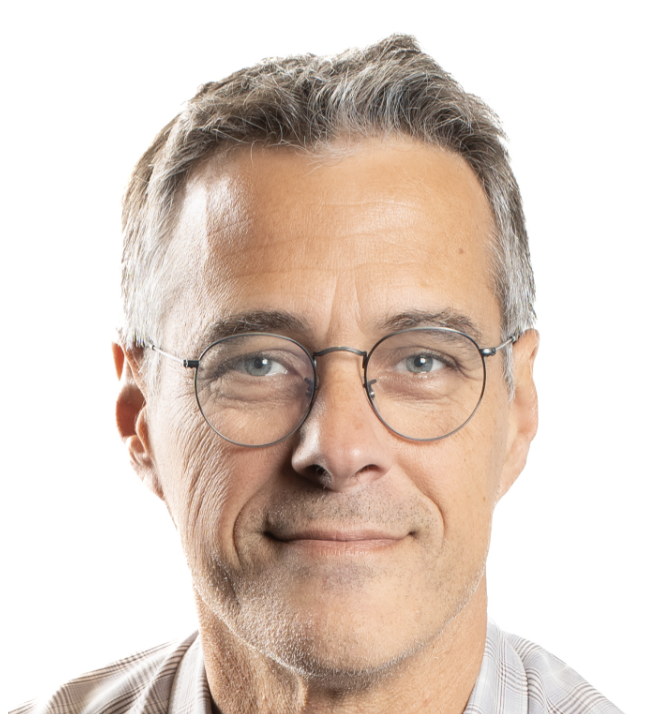
Jean-Michel Bruel
Professor, U. Toulouse Jean Jaurès
Jean-Michel Bruel is a full professor at the University of Toulouse. Its research includes the development of software-intensive Cyber-Physical Systems, as well as methods/model/language integration, with a focus on Requirements and Model-Based Systems Engineering. He has served as the Laboratory Representative for Toulouse 2 Jean Jaurès University from 2016 to 2020. He has been a member of the Strategic Research Committee of the IRIT CNRS laboratory since 2021. He has been the holder of the Chair of Model-Driven Systems Engineering between AIRBUS and Toulouse Jean Jaurès University since 2022, and joined the International Research Laboratory in AI in 2023. He is co-lead the GDR CNRS SciLog for the next 5 years.
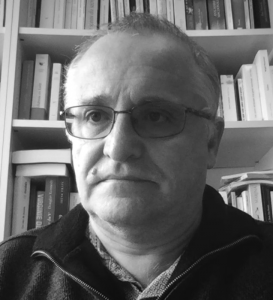
Antoine Beugnard
Professor, IMT Atlantique
Antoine Beugnard obtained his PhD in computer science at Université de Rennes 1 in 1993 and has been a professor in the computer science department of Telecom Bretagne, now IMT Atlantique, since December 2007.
He has previously worked for Michael Jackson France, where he developed an environment in Smalltalk for the JSD method (Jackson System Development).
After becoming interested in the semantics of late binding in object-oriented languages, contract-oriented specifications, and communication abstractions, his recent fields of interest are modelling (its meaning, its notations, its features such as composability, etc.) and the static analysis of names in the context of heterogeneous languages.
Since 2017, he has been applying his research to the “Factory of the Future” field, and more specifically to digital twins.
Participating Partners:


Project Implementation
The project is structured into three interconnected work packages, addressing methodology, continuous engineering, collaborative tools, and sustainability.
Workpackage1: Methodology and Life Cycle
Leader: IRIT/SM@RT (Univ. Toulouse Jean Jaurès)
Partners : Diverse (Inria), P4S (IMT), CEA-List
Objectives:
- Develop domain-specific language for DT engineering (SysML V2 extension)
- Define architecture framework following ISO42010
- Establish reverse engineering methodologies for existing systems
Key Tasks:
- Create domain-specific modeling language (Artemis-DSL)
- Define stakeholders, concerns, and viewpoints for comprehensive DT coverage
- Develop reverse engineering approaches for legacy system integration
Workpackage2: Continuous Engineering, Co-evolution, and Quality
Leader: LaBRI (CNRS)
Partners: DISP (Univ Lumière Lyon 2), Diverse (Inria), IRIT/SM@RT (Univ. Toulouse Jean Jaurès), List (CEA), Spirals (Inria), IGN, TSCF (INRAE)
Objectives:
- Manage co-evolution between physical and digital twins
- Implement live-modeling and programming approaches
- Develop VVUQ methods (Verification, Validation, Uncertainty Quantification)
- Automate conformity assessment using AI and MBSE
- Develop continuous deployment strategies for edge and cloud
- Create environmental impact assessment frameworks
- Implement SustainableDevOps practices
- Integrate analysis-in-the-loop for real-time decision support
Key Tasks: . Develop co-evolution management frameworks . Create continuous integration methodologies for DT . Implement VVUQ methods integrated into development lifecycle . Automate conformity assessment with AI-driven tools . Establish continuous deployment methodologies for DT . Develop sustainability assessment framework based on ADEME’s PCR . Implement eco-design guidelines for DT lifecycle . Create analysis-in-the-loop integration for performance optimization
Workpackage3: Collaborative Engineering and Augmented IDE
Leader: List (CEA)
Partners: Diverse (Inria), P4S (IMT)
Objectives:
- Create collaborative development environments for multidisciplinary teams
- Develop AI-augmented IDE with human-bot inclusion
- Implement concurrent and agile engineering methodologies
Key Tasks:
- Design sustainable collaborative IDE (Artemis-IDE)
- Integrate AI and GenAI capabilities for development assistance
- Ensure human-bot inclusion and accessibility for all users
- Enable space-time collaboration for distributed teams
Related publications
A Model-Based Framework for Developing DTs in Industry 4.0
Lina Bilal, Benoit Combemale, Jean-Marc Jézéquel, Quentin Perez • 2026
Conference Paper • 22nd European Conference on Modelling Foundations and Applications (ECMFA 2026)
Evolution at the Core of Digital Twin Engineering
Tarek Alskaif, Önder Babur, Francis Bordeleau, Loek Cleophas, Benoît Combemale, Joachim Denil, Øystein Haugen, Judith Michael, Phu H. Nguyen, Tiberiu Seceleanu, Mark van den Brand, Hans Vangheluwe • 2025
Conference Paper • EDTconf 2025 - 2nd International Conference on Engineering Digital Twins
Engineering Digital Twins: A Research Roadmap
Benoît Combemale, Pascale Vicat-Blanc, Arnaud Blouin, Hind Bril El Haouzi, Jean-Michel Bruel, Julien Deantoni, Thierry Duval, Sébastien Gérard, Jean-Marc Jézéquel • 2025
Conference Paper • EDTconf 2025 - 2nd International Conference on Engineering Digital Twins
Related positions
Improving Sustainability in the Physical-to-Digital Twin Continuum: A Middleware Framework for Adaptive Deployment
PhD position in the area of sustainable middleware for digital twins.
- Master degree in relevant field
- Experience with digital twins
- +2 more requirements
Methodology for Engineering Digital Twins
The goal is to define a generic methodology that covers the whole digital twin lifecycle.
- PhD in computer science
- Programming skills
- +2 more requirements
Ongoing Research Positions
Agents as Run-time Exploratory Programmers for Digital Twins
This PhD investigates how LLM-enabled autonomous agents can act as run-time exploratory programmers for digital twins, enabling live what-if scenario exploration without manual implementation of complex language support or state migration, by directly interacting with executing systems through existing interfaces and continuous feedback.
Modeling the construction of digital twins
The goal is to develop an environment for building and executing digital twins based on a digital twin model and its lifecycle.
AI-Assisted Model-Driven Security Engineering for Digital Twins: Toward an Automated Round-Trip Framework
This PhD thesis has the objective to address the challenges of modeling Digital Twins by integrating Artificial Intelligence (AI) assistance, enhanced security modeling, simulation and round-trip feedback.